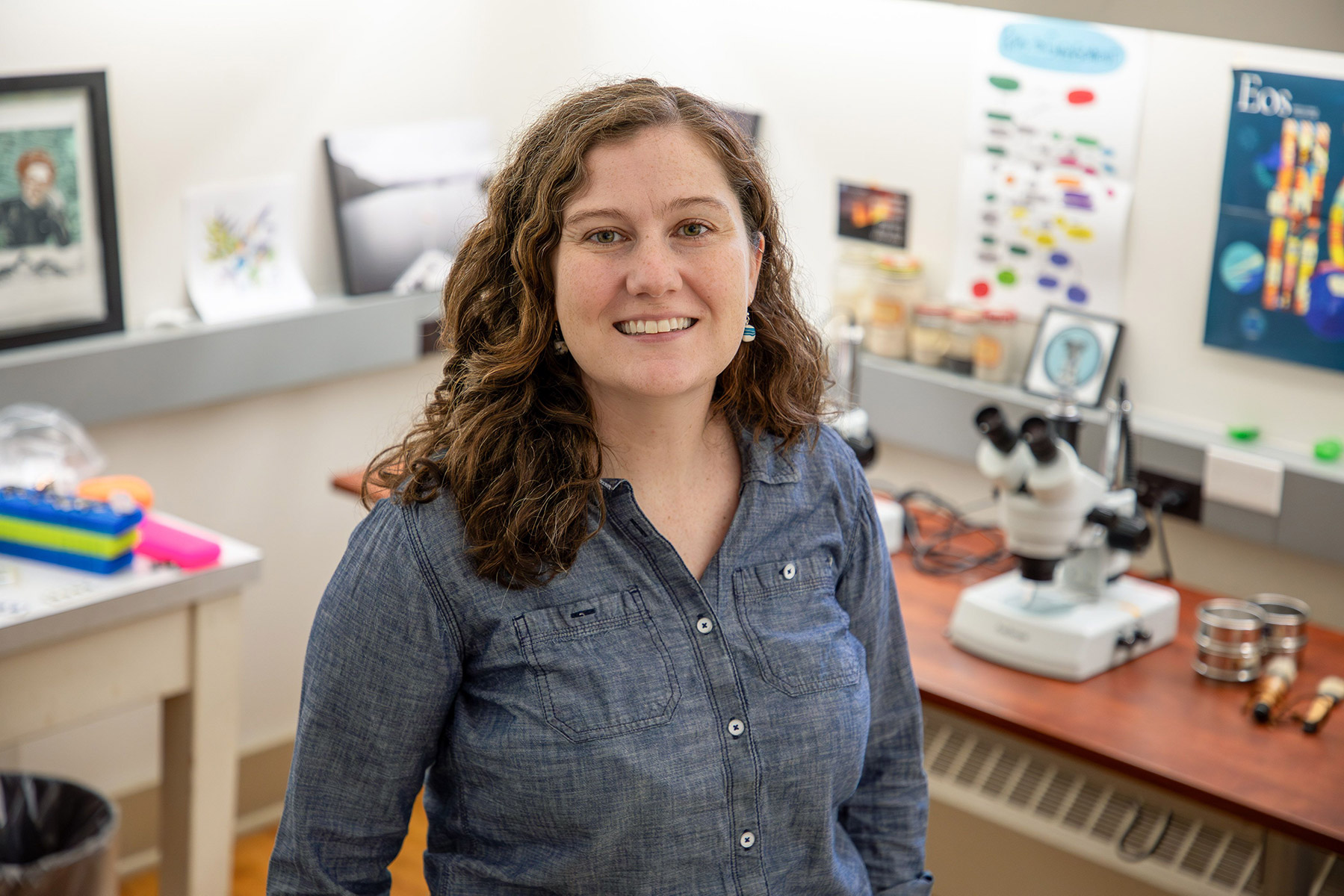
Laura Haynes
Laura Haynes is a geochemist who investigates climate and ocean change throughout Earth’s history. She primarily does this by studying small marine protists called foraminifera. These ubiquitous creatures- found from the Hudson River to the most remote regions of the open ocean- make hard shells out of calcium carbonate and are key players in the ocean’s carbon cycle. They are also widely preserved in the fossil record, and their shell geochemistry records past ocean temperature, pH, and oxygen levels. She is currently investigating the impact of Ocean Alkalinity Enhancement, a proposed climate solution, on foraminifera calcification and geochemistry. She also works on past climate reconstructions and the use of foraminifera as a monitoring tool in the Hudson River Estuary. Her courses explore the past, present, and future of the ocean and climate system.
Laura Haynes is a geochemist who investigates climate and ocean change throughout Earth’s history. She primarily studies small, ubiquitous marine protists called foraminifera. For her dissertation, she gained expertise growing living foraminifera in the laboratory, with the goal of better understanding how their shell geochemistry records ocean acidification and warming events in the geologic past. Her work is now focused on understanding how foraminifera would respond to a carbon dioxide removal strategy called Ocean Alkalinity Enhancement. She has undertaken foraminifera culturing experiments at the Catalina Island Wrigley Institute and the Bermuda Institute of Ocean Sciences with Vassar students, aiming to pinpoint the precise controls on foraminifera calcification. She also works on fossil foraminifera found in deep-sea sediments in order to reconstruct past ocean biogeochemistry and ecological dynamics. In 2020 she sailed on the International Ocean Discovery Program’s Expedition 378, where the team recovered a new deep-sea sediment record of South Pacific Ocean conditions during a period of profound planetary warmth (57-45 million years ago). She and her students are working to generate a stable isotope record of past temperature and carbon cycle dynamics from this site.
Haynes received her B.A. from Pomona College in Geology and her Ph.D. from Columbia University in Geochemistry and Paleoceanography. Her courses explore the past, present, and future of our planet’s biogeochemical systems, including ESCI-153 The Fluid Earth, ESCI-277 Biogeochemistry, ESCI-325 Mass Extinctions, ESCI-204 Earth History, and ESCI-353 Ocean Based Climate Solutions.
Contact
Box 229
Research and Academic Interests
Climate Change, Oceanography, and Geochemistry
Departments and Programs
Courses
ESCI 153 The Fluid Earth: Oceans, Atmosphere, and the Climate System
ESCI 325 Mass Extinctions
ESCI 277 Biogeochemistry
ESCI 353 Ocean Based Climate Solutions
ESCI 204 Earth History
Grants, Fellowships, Honors, Awards
Vassar Professor Awarded Climate Research Grant
Laura Haynes, Assistant Professor of Earth Science on the Mary Clark Rockefeller Chair, will lead a comprehensive initiative to explore this question as a recipient of a $480,415 research grant from the National Oceanographic and Atmospheric Administration (NOAA).
Professors of Earth Science acquire grant for SEM microscope and EDS spectrometer
Professors of Earth Science Laura Haynes, Kirsten Menking, and Jeffrey Walker received a National Science Foundation Earth Sciences Instrumentation and Facilities (EAR/IF) grant to acquire a Tabletop Scanning Electron Microscope (SEM) and Energy Dispersive X-Ray Spectrometer (EDS).
In the Media
Photos
Download images for non-commercial use, photo credit required.